Types Of Payment Gateways In India & How To Choose Right One
December 11, 2025
The digitization has enabled us with a number of opportunities, from connecting with the right business audience, improving business productivity, and more. But what about a payment system for your business’s payin and payouts, and top features like instant settlement? Getting started with a payment gateway in India can be a game-changer for your organization.
According to the latest research, 93% of global consumers say pricing in their local currency affects their purchase decision, which also highlights the value of localized processing. Moreover, 32% of consumers like cross-border shopping for increased product availability.
Business decision makers can leverage a payment gateway for their business. In order to get rid of the traditional way to accept payments, disburse salaries, manage spending, and get top benefits like auto reconciliation, analytic reports for better decision making, to get insights into customer behaviour towards their purchase, and more.
In this guide, we will discuss all about payment gateway types and choosing the right type for your business needs. So you start leveraging PG for your company in a more effective way.
Let’s get started.
The payment gateway meaning can be defined as a bridge between a business and its customers. It enables both parties to make easy and simple digital payments without any barriers, such as a customer making a payment, choosing their preferred payment methods from Unified Payment Interface (UPI) to net banking, and more. On the other hand, businesses can accept payments with no extra effort, which consumes most of their time.
Gateway Services offers a number of benefits for an organization, including reconciliation, auto payin with top features like recurring, subscription, payment link, and more.
Must Read: Why Choose Wonderpay Payment Gateway for Your Business
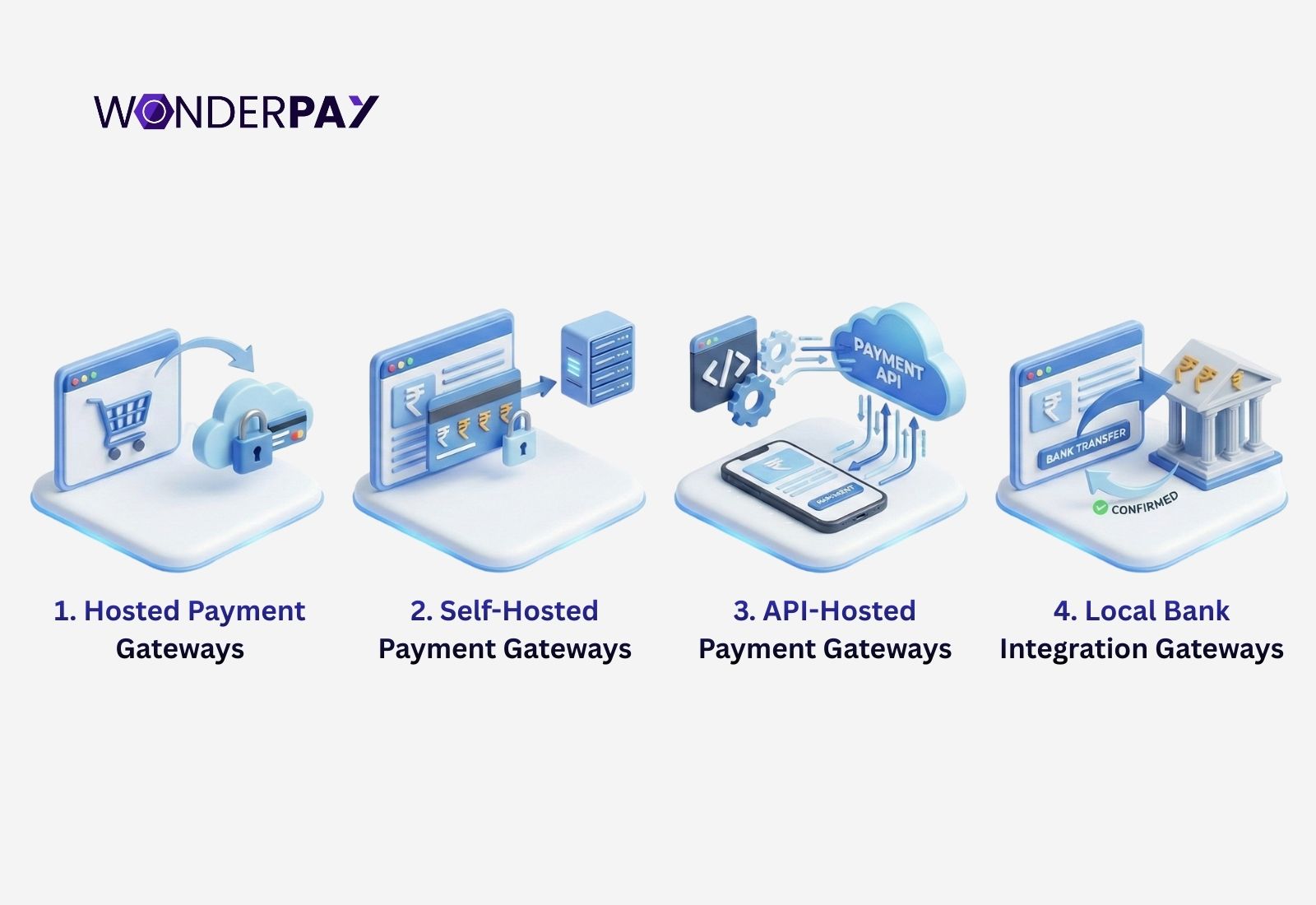
There are four main types of payment systems that you must know. This section will introduce you to all of the types with details.
At the end of this payment gateway list, you will be able to make an informed decision. In order to choose the right platform for your business needs.
It is a payment processing service that directs customers from a merchant’s website to a secure, third-party payment page for the purpose of making a successful transition. Within this process, the responsibility of handling sensitive payment data as well as maintaining security compliance is offloaded from the business to a payment gateway service provider.
The working of a hosted PG is simple and completes within 5 steps. Here is how it works to help you get a clear understanding, step by step.
Customer Buy and Checkout: Once the customer adds items and clicks the buy now button.
Redirecting: Customer is redirected to a payment page, which is hosted by your digital payment service provider.
Enter payment details: Now the buyer enters the payment details on the gateway’s page, not on the merchant’s website.
Transaction processed: Payment is processed securely, while keeping security as a priority, including fraud checks, and handles the transaction authorization.
Return to the site: Buyer redirected back automatically to the merchant’s website with a message either payment successful or failed based on the payment details the buyer entered.
Simplicity: This is the best solution for small businesses that are looking for an easy and simple way to utilize a payment gateway for their digital payments.
A secure system: The best of payment gateway types, such as hosted, eliminates the need for storing or processing sensitive payment data, which is one of the mandatory practices by the Payment Card Industry Data Security System (PCI DSS) and the Reserve Bank of India (RBI). This significantly reduces the burden of security compliance by the regional authority bodies.
Reliable platform: payment gateways come with robust technology that offers you a security infrastructure and maintenance, which ensures a reliable transaction process.
Space for scalability: This solution handles a growing number of transaction volumes. It does not require a business to invest in additional technical resources.
These types of payment systems help you in driving a connected experience at the same time, collecting your business customers’ information for each payment on your brand site. It delivers you benefits such as a seamless and branded checkout experience for your company. An Application Programming Interface (API) gateway provides you with a secure transaction process off-site via the provider’s servers.
If you are looking for full control over a payment gateway to align with your brand. API hosted service offers you customization with no merchants handling sensitive data directly. This is an ideal solution for businesses that need control but with less security burden than self hosted, requiring developer skills for integration of the system.
Customer enters details: Customer enters payment details after choosing the items or services you sell. It could be over your business website or mobile application, also.
API Call: Application programming interface within your website or app sends the payment details to the provider’s server securely.
Payment processing: Now the provider handles authorization with banks and then processes the payment off-site.
Confirmation: API plays a significant role, as it sends back the result, while the customer stays on your platform for confirmation.
Technical Skill: it will require a development team in order to have the implementation of the API PG and its maintenance, as the provider will let you know.
Shared Responsibility: As your provider for payment services will secure the data; simultaneously, you will need to manage the integration security as needed.
Getting started with a self-hosted payment gateway will process all of your company’s transactions directly on your own server. These types of gateways allow companies like yours to have full control over the checkout experience for your customers. You can have your brand’s consistency with the customization you need.
It requires you to handle the security yourself, which will include the PCI compliance and Secure Sockets Layer (SSL) encryption, as well as managing the system by yourself. So this is the best option for all those businesses that have technical expertise or can spend on that by hiring an expert and resources to manage these responsibilities.
When it comes to the self-hosted gateway’s work. You will see it involves installing and integrating payment processing software, which will be done on your company’s website or its server.
This will allow your customers to enter his or her payment information directly on your website. And then the data is then sent to a third party for the purpose of authorization.
Here, your organization will be responsible for the security as well as the compliance of the system. It will include shielding the payment data and also adhering to standards such as the Payment Card Industry Data Security System.
Complete control: You will have full control over the checkout for a better experience**.** It will enable you to customize the look as you want and feel of the payment page in order to align with your brand, which will assist in leading to a more cohesive customer experience, as it is more important.
Space for conversion: It offers you a customization option that enables you to optimize your website or app’s payment page to maximize conversion rates, and at the same time you will experience less number of abandonments.
More security: Did you know that you are directly responsible for securing payment information? It requires technical expertise as well as all the resources to ensure compliance with standards such as PCI DSS.
Technical management: within this, you will be responsible for the setup, configuration, security, including the maintenance of the system. It will also include handling any technical issues if any arise.
Higher cost and effort: It will need to have more investment in technical expertise and infrastructure. If you compare it to a hosted solution that a business usually seeks.
Self-hosted payment gateway services are best for all those organizations that prioritize a fully customized checkout experience for their business customers. And have the technical resources, as this will include the dedicated IT team of your own or one that you will hire or outsource, to manage the security and upkeep of the system.
The local bank integration is a payment method. Within this system, a business directly connects its online platform for the purpose of a specific local bank’s system. So, it can let customers pay from their bank accounts while keeping its offer with lower fees, and more benefits, such as faster processing, as well as local trust, though it is often limited to one country or region and requires bank approval, including technical setup, which is also an important step.
The local bank system redirects customers to their bank’s secure portal to initiate the authorized payment, with funds settling directly, which will be done to the merchant’s account.
Checkout: First of all, your customer will select products or your service you are providing and proceed to checkout.
Redirection: within this step customer is redirected to a secure interface, which can often be their bank’s login also.
Authorization: Now, the buyer (customer) logs in and authorizes his or her payment.
Processing: Payment gateways will securely communicate with the local bank in order to verify funds that need to be paid.
Confirmation: In the last step, the bank will send confirmation back; the initiated funds are transferred directly to the merchant.
It offers you a lower cost solution: This system will help you in reducing reliance on third-party processors, which means having the benefits of lower transaction fees.
Faster Settlements: Within this, you will notice that the payments stay within the local banking network, which will help you speed up processing.
Builds trust: Using the local bank, which is familiar to the customer, helps you in higher customer confidence.
You get direct control: Your organization will have complete control over the payment flow.
Limited Reach: This system is primarily for local or domestic transactions only; if you accept payments from outside the country, it is not for your company.
Technical Effort: It will require you to hire or outsource significant technical resources for its proper setup and maintenance also.
Dependency on the bank: It is subject to the local bank’s technology, which may cause you to face potential downtime.
Approval Process: You will need to wait for the approval of the bank. This practice could be longer for your business settlements.
These are significant payment gateway examples, hope it clears your doubts about using the rich solution for your use. This complete list with their qualities and the drawbacks will make an informed decision to get the solution you are seeking to fill your business payments gap.
Also Read: Payment Gateway Charges Guide for Businesses
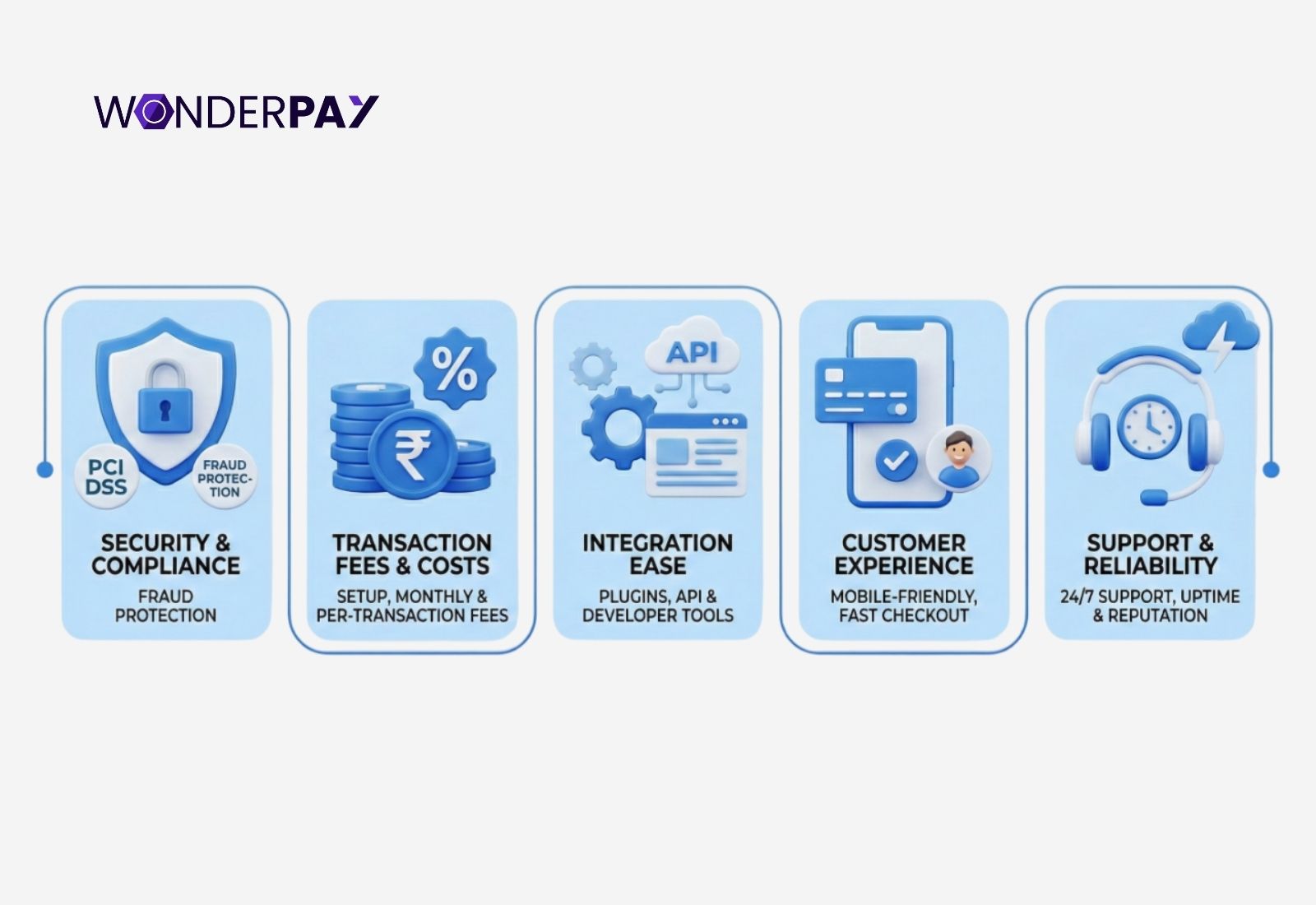 Getting started with one of the best PGs in the payment gateway list. It will require you to carefully evaluate several critical factors. In order to ensure it aligns with your business needs, as well as provides you with a smooth experience for both your business and your customers who buy by connecting with you.
The payment solution you choose for your organization. It must be easy to integrate within your existing system, whether it is for your mobile application, or website. Whatever the solutions you choose among API gateway, self-hosted, hosted PG, to local bank.
You will get the complete documentation for your use, including its other formalities, such as unique keys that you will need to enter while integrating the API gateway. This way, you get the best solution for your company that aligns with your needs as required.
You must ensure the gateway you choose supports all the payment methods that your business customers are familiar with. Whether major credit cards such as Visa, Mastercard, Amex, digital wallets including UPI, as well as the local payment options that are relevant to your target markets. So, getting to have a diverse offering will help you in maximizing sales conversions also which is more important for any organization.
You should opt for a PG provider that has a strong track record for reliability, compulsory security such as PCI compliance, including minimal downtime. Connecting with a well-regarded brand will sow trust in your customers, while making them more likely to complete their purchases.
Check out their pricing model, and you can look beyond the basic per-transaction fee, including investigating other potential costs. It can focus on having the provider’s setup fees, which they are charging, monthly maintenance charges, refund/chargeback fees, and hidden costs that you must clear at first glance. Select the online payment gateway structure that is transparent and makes financial sense for your business volume.
The quality of your payment service provider’s developer documentation matters most for a smooth and also its quick integration process. Therefore, you, as a decision maker, look for comprehensive guides that the provider should give you, clear APIs, and readily available libraries for your specific technology stack.
More features mean more space to improve your customer experience. So, consider what features are essential that will assist you in your business operations. The common features of a payment gateway in India**,** such as Wonderpay, include recurring billing for subscriptions, support for multiple payment options, fraud detection tools, and a simple checkout user interface, which is a must.
What is their onboarding process to start using the payment solution immediately? Whenever you start with a service provider. They should deliver a smooth and efficient onboarding and verification process is important. You will need to understand the required documentation and the typical timeline, as well. It will be for getting your account fully operational, which helps you avoid delays in going live.
There are different payment gateway types; ultimately, the one should improves your business by reducing friction, which usually occurs at checkout. A better solution will provide an excellent customer experience.
The time you get a seamless, secure, and fast payment process will always directly contribute to lower cart abandonment rates; it is one of the factors. Instead, it should increase your company’s targeted customers’ satisfaction.
Thoroughly evaluating the factors will support you in selecting a payment gateway that provides reliable service, integrates easily with your systems, and helps grow your business.
Suggested Reads: Guide to Payment Gateway Integration for Websites
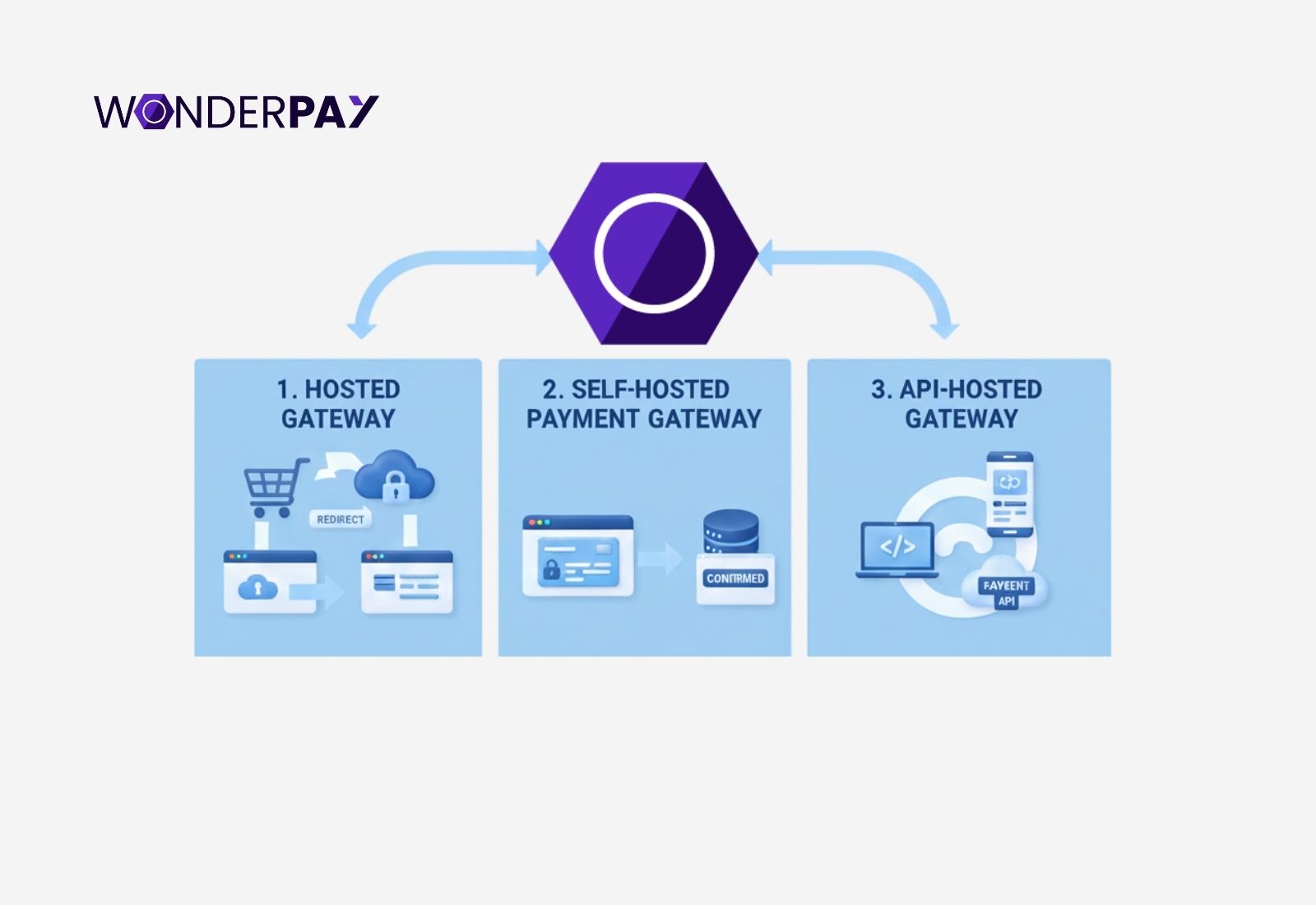 Wonderpay is a full-stack payment gateway solution provider as well as a comprehensive payment platform. It enables Indian businesses to accept, process, and disburse online payments. It does not matter what methods a business’s customers are familiar with.
Wonderpay PG will help allow you to accept payments across Unified Payment Interface (UPI), cards, wallets, net banking, EMIs, including trending solutions like Buy Now Pay Later (BNPL), acting as a crucial intermediary for seamless transactions for startups to large enterprises.
WPay PG solution is identified for its developer-friendly APIs, security, like PCI DSS compliance, to secure customer-sensitive payment data. You can find out the top features that are beyond basic payment acceptance, including banking and credit solutions, which make it a leading player in India’s digital payment system.
Full-Stack Solution: It offers a broad suite of our products for your business’s needs related to payments and banking.
Multi-Payment Method Support: We help you with integrating credit or debit cards, net banking, UPI, and mobile wallets, as well as EMIs, and PayLater, which your business customers may be seeking a lot.
For All Business Sizes: Our online payment gateway solution caters to e-commerce, startups, and large enterprises. The best part you will like a lot is having space for scalability.
Security Focused: We take payment security seriously and put practices like PCI-DSS compliance as the first priority, with strong fraud prevention.
Developer-Friendly: WPay’s easy integration with APIs, as well as our developed user-friendly dashboard, will improve your experience.
We have learned; there are different types of payment gateways in India, such as hosted payment gateway, API hosted payment gateway, self hosted payment gateway, and last but not least is local bank integration. So, choosing the right digital payment solution for your business depends on your requirements.
Now, you have a clear picture, what these types are, how they work, what their advantages and disadvantages including the use case. So, get ahead and start with digital payments with a PG solution your organization needs.
Still in fog? Don’t worry, connect with us right now, and get a free consultation for the payment gateway you need.
It is a crucial technology and merchant service. It supports all types of e-commerce models, from business to consumer (B2C) to business to business (B2B). A payment gateway is not a type of e-commerce itself.
A PG such as Wonderpay acts as a secure digital bridge, processing a business all online payments securely, transmitting customer payment information to the merchant’s bank, and relaying the approval or decline to the customers.
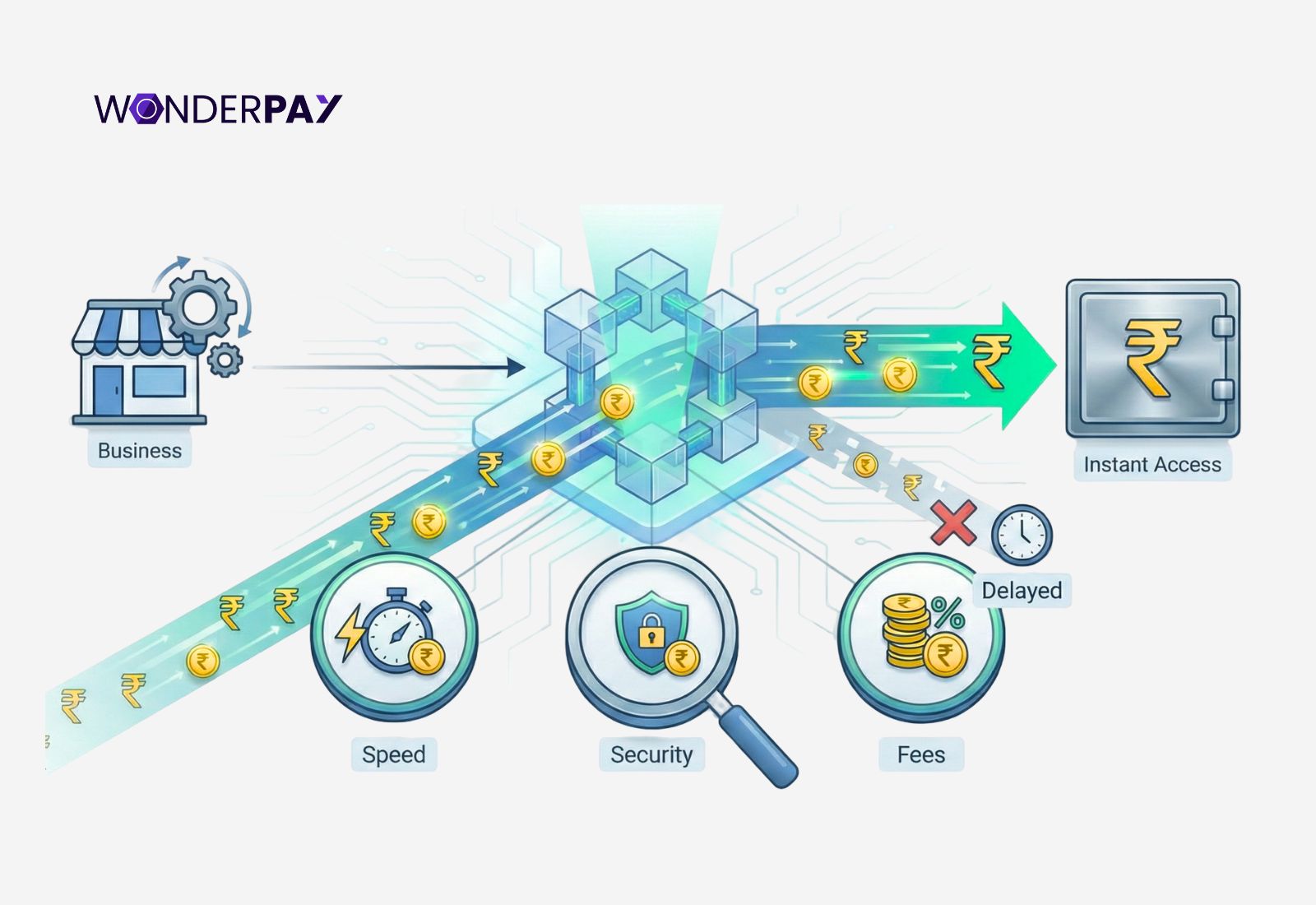
It is a transaction process that is so smooth, fast, and intuitive. When the customer makes a payment, the payment gateway should eliminate friction, such as redirects or extra steps. This allows them to pay effortlessly within the merchant’s site or mobile application to let them experience higher satisfaction and conversion.
Seamless transactions mean invisible and integrated, whether online, in-store, or mobile, often using technologies including tokenization for security, with no disruption at all.
There are different payment gateways, and all have their own pricing system. A payment gateway in India may charge a Merchant Discount Rate (MDR) of 1.5 to 3% transaction; it could be less or more, varying by the payment method your customer chooses, including platform fees, settlement charges. It will be beneficial if you ask your provider for the price first.
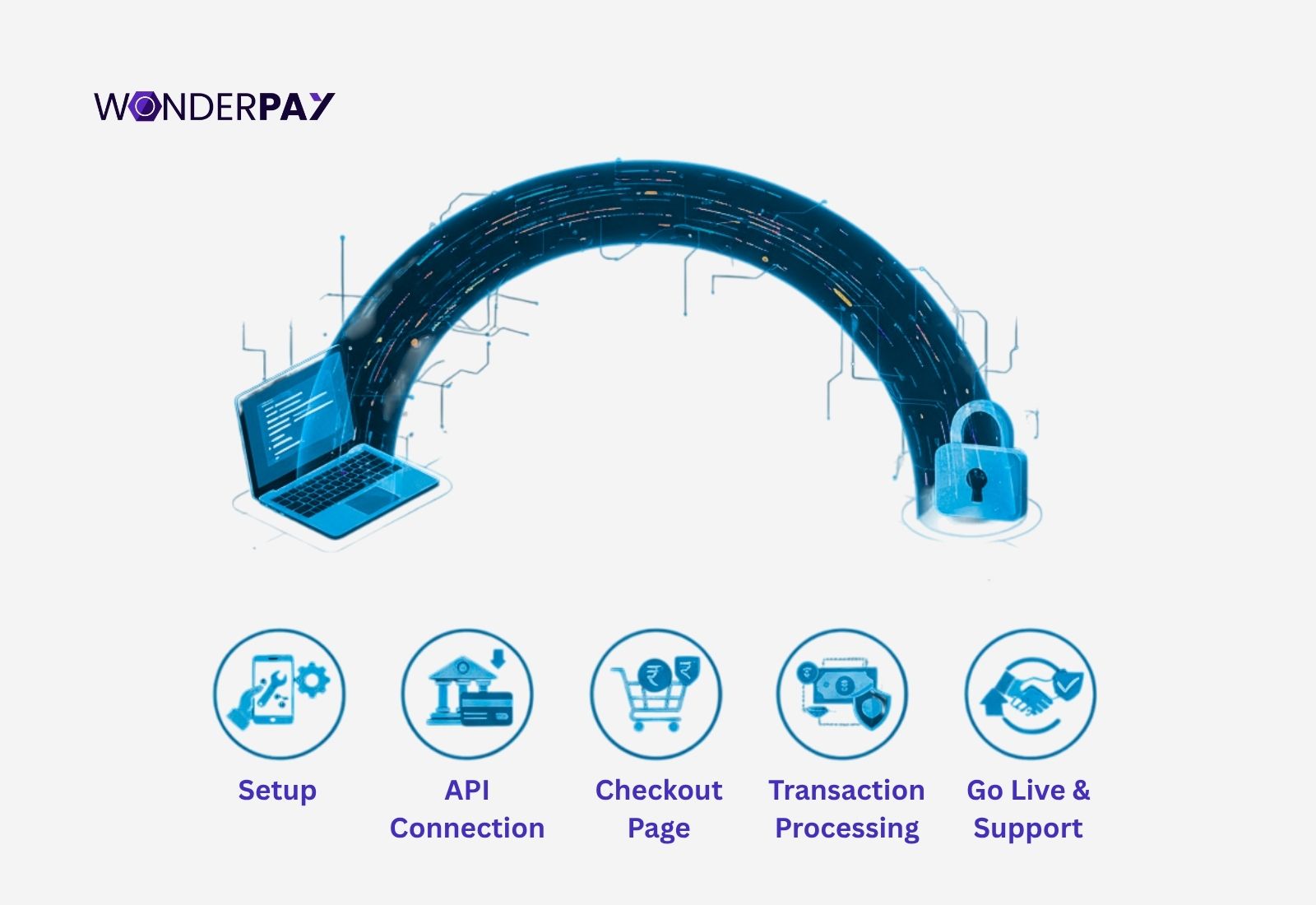
You can easily integrate a payment gateway into your business website. You just need to follow 6 steps that are as follows:
First of all, choose a reliable payment gateway service provider. Now, sign up by submitting your business and KYC details. In the third step, you need to configure your account and integrate the gateway into your app or website using APIs or a plugin. Lastly, test the integration in a sandbox first. If okay, now you can start accepting or disbursing payments.
Wonderpay is the best payment gateway in India. It is known for its reliable infrastructure to assist a huge number of businesses of all sizes. WPay offers merchants with affordable prices, easy integration, recurring payments, EMI option, Buy Now Pay Later, and makes all your significant payments, such as tax, GST, and more, simple with its robust dashboard, which is designed keeping all types of users in mind.
You can get a number of other benefits that will assist your organization in growing your business in accepting or disbursing payments in the growing digital era.

“With a background in journalism and over 4 years of experience in content marketing, Kamaljeet Singh specializes in fintech storytelling. He transforms complex financial technologies into engaging, SEO-friendly content that helps businesses build authority and connect with their audience.”